Keeping a loved one with dementia safe before a memory care move
By Nathan Ibrahim · Updated 2026-08-04
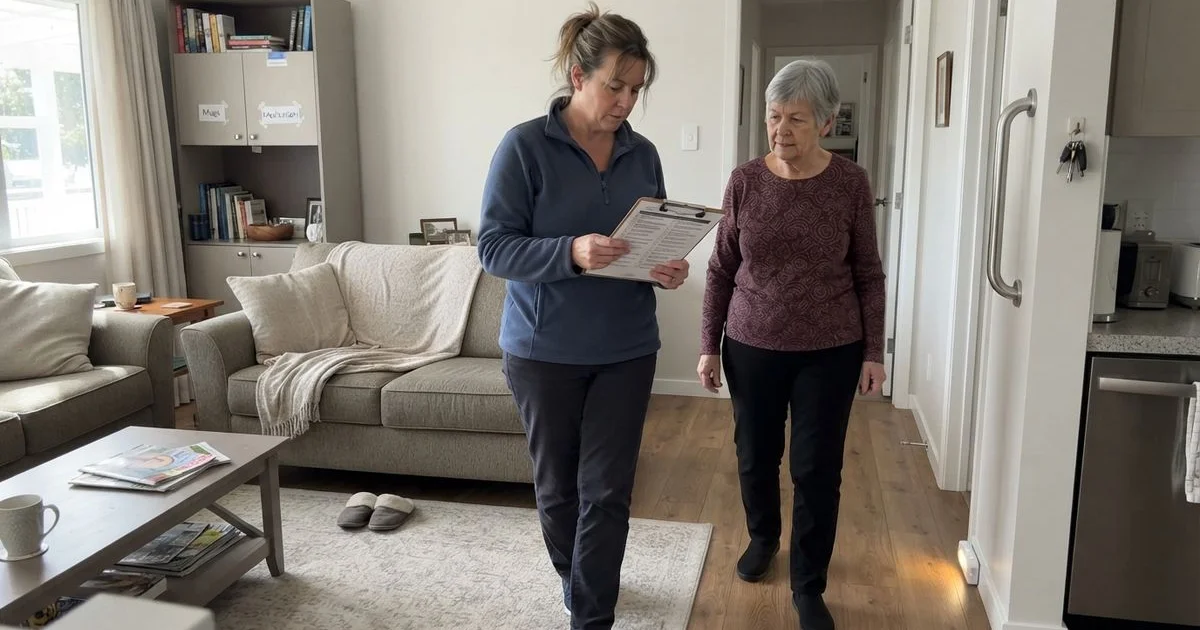
There’s usually a stretch of time between a dementia diagnosis and an actual move into memory care, sometimes months, sometimes years, where a family is trying to keep someone safe at home while weighing when a move becomes necessary. This guide covers the practical safety steps that matter most during that period, and the signals that suggest the timeline needs to move up.
This is general information, not medical advice. A doctor or care manager familiar with the specific situation can help judge timing and safety needs more precisely.
The two risks that matter most
Wandering and falls account for the majority of serious safety incidents families describe. Wandering is particularly dangerous because it can happen suddenly, even in someone who has never shown a tendency to leave before, and it often happens at night or during a moment when a caregiver briefly isn’t watching. Falls matter because they frequently lead to a hospitalization, and a hospitalization is one of the most common events that accelerates a move to a higher level of care.
A home safety checklist
| Risk area | What to check or change |
|---|---|
| Doors and exits | Add door alarms or chimes; consider a lock placement that’s harder for a confused person to manage without blocking emergency exit |
| Stove and cooking | Use a stove shutoff device, remove knobs, or disconnect if forgetting to turn it off has already happened |
| Falls | Remove loose rugs, improve lighting, install grab bars in the bathroom, secure stairs |
| Wandering identification | A medical alert bracelet or GPS tracker in case someone does leave unsupervised |
| Medication | Use a locked or monitored dispenser rather than relying on memory for timing and dosage |
| Water and bathing | Set water heater temperature to prevent scalding; consider a walk-in shower if mobility is also declining |
Watching for the signals it’s time to move
Families often wait longer than they should, hoping the situation stabilizes. A few signals are worth treating as a real deadline rather than something to monitor further: any wandering incident, even a brief one; a fall, especially one requiring medical attention; a stove or oven left on more than once; or a primary caregiver reaching a point of exhaustion where consistent supervision is no longer realistic. Caregiver burnout itself is a safety risk, not just a hardship, since an exhausted caregiver is more likely to miss something important.
Getting support before you’re at a breaking point
Caregiving for someone with dementia at home is demanding in a way that’s hard to fully anticipate until you’re in it. Adult day programs, where a person spends daytime hours in a supervised setting with structured activities before returning home in the evening, can give a caregiver real relief without requiring a full move. Short respite stays at a memory care community serve a similar purpose over a longer stretch, a few days to a few weeks, and can also give both the caregiver and the person with dementia a low-stakes preview of what a community environment feels like.
Local caregiver support groups, whether in person or online, are also worth seeking out early rather than waiting until you’re overwhelmed. Other families further along in the process are often the most useful source of practical, specific advice, the kind that doesn’t always show up in a general guide like this one. Memory care itself costs more than standard assisted living once secured units and higher staffing come into play; our memory care cost guide breaks down what drives that.
Making the home safer isn’t a permanent fix
It’s worth being honest with yourself about what home safety measures can and can’t do. Door alarms, stove shutoffs, and grab bars reduce risk, but they don’t replace supervision, and as dementia progresses, the level of supervision needed usually increases faster than home modifications alone can keep up with. Many families use this period to start touring memory care communities even before they’re ready to move, so the decision doesn’t have to be made under emergency pressure later.
If a wandering incident, a fall, or a close call has already happened, treat it as useful information rather than something to explain away. It’s often the clearest signal that home safety measures have reached their limit.
See our scoring methodology for how we evaluate memory care providers, or visit the home page to start browsing options in the region.
Common questions
- How do I know if it's time to stop waiting and move to memory care?
- A few signals matter most: a fall or near-miss, a wandering incident where the person left the house unsupervised, a stove or oven left on repeatedly, or a caregiver reaching a point of exhaustion where safety can no longer be reliably monitored. Any one of these is worth treating as a real deadline rather than a reason to wait longer.
- What's the biggest safety risk at home for someone with dementia?
- Wandering and falls are the two most commonly cited safety risks. Wandering because it can happen quickly and without warning even in someone who's never left before, and falls because they often lead to a hospitalization that accelerates the need for a higher level of care.
- Do door alarms actually work to prevent wandering?
- They help, but they're not a complete solution on their own since a determined or confused person can still get out before anyone responds. They work best as one layer alongside supervision, a secured yard, and a plan for what to do if someone does get out.
- Should I remove the stove or cooking access entirely?
- Many families do reach that point, using a stove shutoff device or disconnecting it entirely rather than relying on reminders, since forgetting isn't something a person with dementia can reliably self-correct. It's a hard step but often a necessary one.