Assisted living vs. memory care vs. skilled nursing: how to know which level of care fits
By Nathan Ibrahim · Updated 2026-07-14
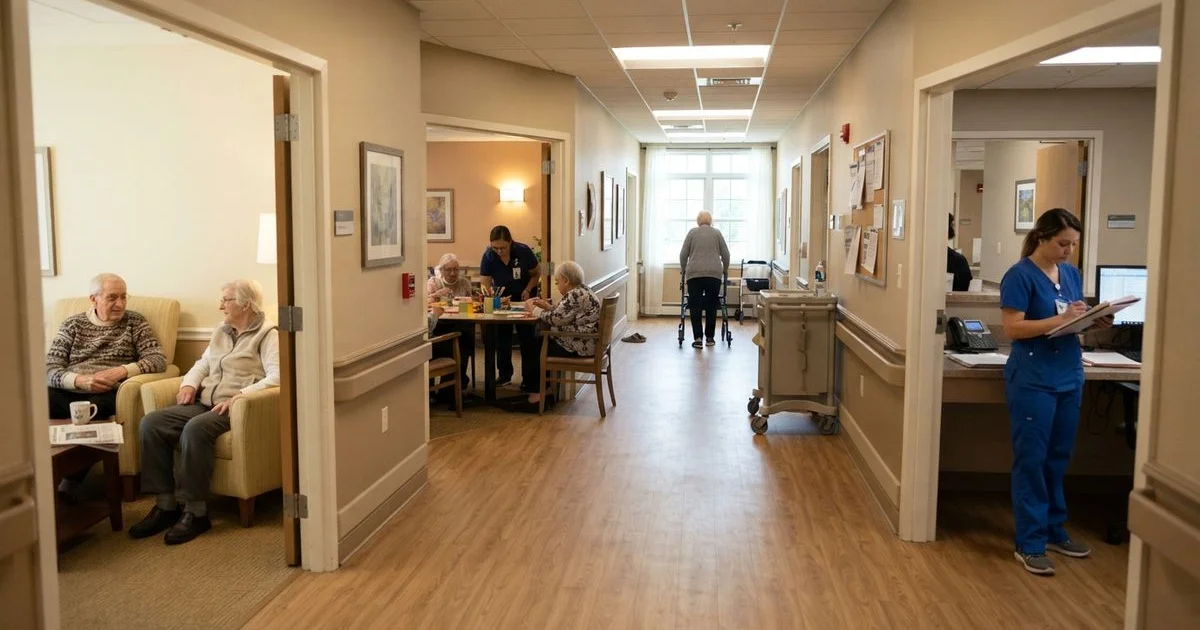
Families often start searching for senior care without knowing which category actually fits. The three main levels, assisted living, memory care, and skilled nursing, sound similar but cover very different kinds of support. Getting the category right early saves time, since touring the wrong type of community usually means starting the search over.
What each level actually covers
Assisted living is built for people who can mostly manage on their own but need help with some daily tasks: bathing, dressing, medication reminders, meals. Residents typically have their own apartment or room and come and go with some independence.
Memory care is a more secure, structured version of assisted living, purpose-built for people with Alzheimer’s, dementia, or other cognitive impairment. It adds secured entrances and exits, staff trained in dementia-specific behaviors, and a higher staff-to-resident ratio, particularly during the hours when wandering and confusion are more likely.
Skilled nursing provides licensed medical care: wound care, IV medications, tube feeding, post-surgical recovery, and daily oversight from registered nurses. It’s the right fit for someone with ongoing medical needs beyond what assisted living or memory care staff are trained or licensed to provide.
| Assisted living | Memory care | Skilled nursing | |
|---|---|---|---|
| Who it’s for | Needs help with daily tasks, mostly independent | Cognitive decline, needs supervision and structure | Ongoing medical or nursing care needs |
| Typical stay | Long-term | Long-term | Short-term rehab or long-term |
| Security | Standard | Secured entrances and exits | Clinical, hospital-like setting |
| Staffing | Personal care aides | Dementia-trained staff, higher ratios | Licensed nurses, therapists |
| Common trigger | Difficulty managing daily tasks safely at home | Memory loss creating safety risk, wandering | Hospital discharge, surgery, chronic medical need |
How to tell which one actually fits
Start with a simple question: is the primary concern daily task support, cognitive safety, or medical care? If a parent is forgetting to take medication or struggling to cook and clean but is otherwise oriented and safe, assisted living is usually the starting point. If the concern is memory loss creating a real safety risk, wandering out of the house, getting lost, forgetting the stove is on, memory care is the better fit even if the person doesn’t yet need help with every daily task.
Skilled nursing usually enters the picture after a hospital stay, when a doctor or discharge planner says a level of medical care beyond what assisted living can provide is needed, even if that need turns out to be short-term.
It’s common for someone to move between these levels over time rather than land in the right one from the start. A person might begin in assisted living, later need memory care as dementia progresses, or need a temporary skilled nursing stay after a fall before returning to assisted living. Ask any community you’re considering how they handle transitions between levels of care, since this affects whether a future move means a stressful search from scratch or a smoother internal transfer.
What determines the right call
A few practical signals worth weighing:
- Can the person safely leave the house unsupervised, or is wandering a real risk?
- Do they need help with specific daily tasks, or nearly all of them?
- Is there an active medical condition requiring licensed nursing oversight, wound care, IV therapy, or close monitoring?
- Has a doctor or hospital discharge planner already recommended a specific level of care?
If you’re still unsure after weighing these, a geriatric care manager or the discharge planning team at a hospital can do a formal needs assessment and point you toward the right category before you start touring.
A quick way to think about it
Picture the difference between a parent who leaves the stove on once and forgets to take their evening pills, versus a parent who wanders outside at night looking for a house they sold twenty years ago, versus a parent who just had hip surgery and needs a nurse checking a surgical wound daily. The first scenario points toward assisted living, the second toward memory care, and the third toward skilled nursing, even though all three might get lumped together as “needs care” in an initial conversation. Naming the actual concern out loud, safety, cognition, or medical need, usually makes the right category obvious fairly quickly.
This is general information, not medical advice. A doctor, geriatric care manager, or hospital discharge planner can assess a specific situation and recommend the right level of care.
Visit our home page to browse providers across all three levels of care in the Hartford area, and see our scoring methodology for how we evaluate them.
Common questions
- Can a resident move between these levels of care without changing buildings?
- Sometimes. Some campuses offer more than one level of care on site, so a resident can transition as needs change without relocating. Others require a move to a different facility entirely, so it's worth asking a community directly whether they offer this before you rule it out.
- Does a diagnosis of dementia automatically mean someone needs memory care?
- Not necessarily. Someone in the early stages of dementia may do fine in standard assisted living with some extra support, especially if they aren't at risk of wandering. Memory care becomes the better fit as safety and supervision needs increase, particularly around unsupervised exits.
- Is skilled nursing always a long-term stay?
- No. Many skilled nursing stays are short-term rehab after a hospitalization, surgery, or illness, with the goal of returning home or to a lower level of care. Skilled nursing also covers long-term stays for people with ongoing medical needs that require licensed nursing care.
- Who actually decides which level of care someone needs?
- Usually a combination of a doctor's recommendation, a hospital discharge planner if there's been a recent hospitalization, and an assessment done by the facility itself. Family input matters too, especially around a person's daily safety and how they're managing at home.